
Please enjoy with Autumn Enchanted Rest for Children
If you’re interested in our pre-recorded course Enchanted Rest: Yoga Nidra for Children, click below for all the details
And here’s another Yoga Nidra for Children
Your Custom Text Here

Please enjoy with Autumn Enchanted Rest for Children
If you’re interested in our pre-recorded course Enchanted Rest: Yoga Nidra for Children, click below for all the details
And here’s another Yoga Nidra for Children

If you’ve woken up in the night it can be really stressful! Worrying about feeling tired and brain foggy the next day.
Hopefully this yoga nidra can help. It might help you get back to sleep. But if not it can help you get some good quality deep rest.
It includes: body awareness, gentle eye movements, release for the body with gentle squeeze and release, breathing with a long exhale, and a slow spacious body scan.
It doesn’t bring you back at the end.
I hope it helps - let me know!
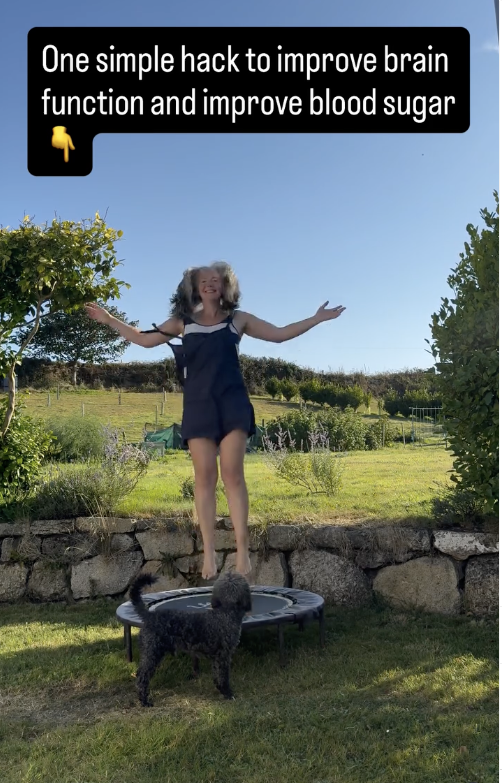
The Hack: do ten minutes of gentle exercise around 30 minutes after a meal
Why it works:
Insulin’s job is to act like a “doorman” that lets sugar from the blood enter your cells, where it can be used for energy or stored for later.
Basically: insulin helps your body move sugar out of the blood and into cells.
But our body can get insulin resistance - for example if we eat too much sugar the body has to produce too much insulin and then the cells stop responding.
Insulin resistance means the sugar stays in the blood (high blood sugar) and doesn’t go into the cells (tired muscles and poor brain function).
Things that can cause insulin resistance:
Excess body fat, especially around the belly: abdominal fat releases substances that interfere with insulin signaling
Physical inactivity: muscles are less efficient at taking up glucose without regular use
Poor diet: high intake of refined carbs, sugar, and processed foods can worsen insulin sensitivity
Genetics: family history can increase susceptibility
Hormonal imbalances: conditions like polycystic ovary syndrome (PCOS) or high cortisol can affect insulin
Chronic inflammation: inflammation in the body can impair insulin’s action
Aging: insulin sensitivity naturally decreases with age
When the sugar stays in your blood and doesn’t enter the cells, your brain and muscles get less glucose which can mean weak tired muscles, poor memory, brain fog, depression and higher Alzheimer’s risk
Excess sugar in the blood is also a big problem, over time it can contribute to problems like inflammation, and increased risk of dementia.
Building strong muscles improves insulin resistance because muscle tissue is one of the main places the body stores and uses glucose—so the more muscle you have (and the more you use them), the more efficiently your body can clear glucose from the blood.
Doing 10 minutes of exercise about 30 minutes after eating can be very effective for lowering blood glucose. This is because after 30 minutes the body has started to process the food and the blood sugar levels go up. The muscles can pull sugar out of the bloodstream without needing as much insulin.
This can improve:
Cardiovascular health
Brain function
Hormonal balance
Balance inflammation
Even light activity, like brisk walking, squats, or climbing stairs, has been shown to reduce post-meal glucose spikes.
Other things you can do include:
Eat a balanced healthy diet
Eat complex carbs that don’t spike the blood sugar so quickly
Increase your muscle mass
Work on your stress levels
Prioritise sleep
Here is a five minute self massage you can do to stimulate the lymphatic system.
This can have lots of benefits including reducing inflammation.
Since some forms of depression are related to inflammation this could potentially help with some depression.
Quisque iaculis facilisis lacinia. Mauris euismod pellentesque tellus sit amet mollis.